WhatsApp Business Automation: Cost & First Steps (2026)
Your customers are already messaging you on WhatsApp. The only question is whether you answer in thirty seconds or three hours. That gap — between the message arriving and you seeing it — is where small businesses quietly bleed money every single day.
I am going to be straight with you about whatsapp business automation: most of what vendors sell you is overkill, and most of what actually works costs almost nothing. After setting this up for service businesses across the US, UK, Canada and Australia, I have a pretty clear picture of what is worth your money and what is not.
What whatsapp business automation actually means
Strip away the marketing talk and WhatsApp automation is just this: when someone messages your business on WhatsApp, something smart happens without you touching your phone. An instant reply. A booking link. A follow-up the next morning. A reminder before the appointment.
There are two completely different ways to do it, and picking the wrong one is the most common mistake I see.
The first is the free WhatsApp Business app. It is the same app your customers use, with a business profile, quick replies, away messages and labels bolted on. It costs nothing. For a one-person operation getting under fifty customer messages a day, it is honestly enough. The quick-reply shortcuts alone will save you an hour a day if you set up twenty or thirty canned answers for the questions you get asked on repeat.
The second is the WhatsApp Business API, which is a different animal entirely. This is what lets you connect WhatsApp to your CRM, trigger messages from your website forms, run proper chatbots and send messages at scale. You cannot get it directly from Meta as a small business — you go through an approved provider, and that is where the costs start.
Here is my rule of thumb: if you are still answering every message by hand and it is eating your evenings, start with the free app and its quick replies. If you are missing messages, losing bookings, or your team is drowning, you need the API route. Most businesses I talk to are somewhere in between and do not know it.
What whatsapp business automation really costs in 2026
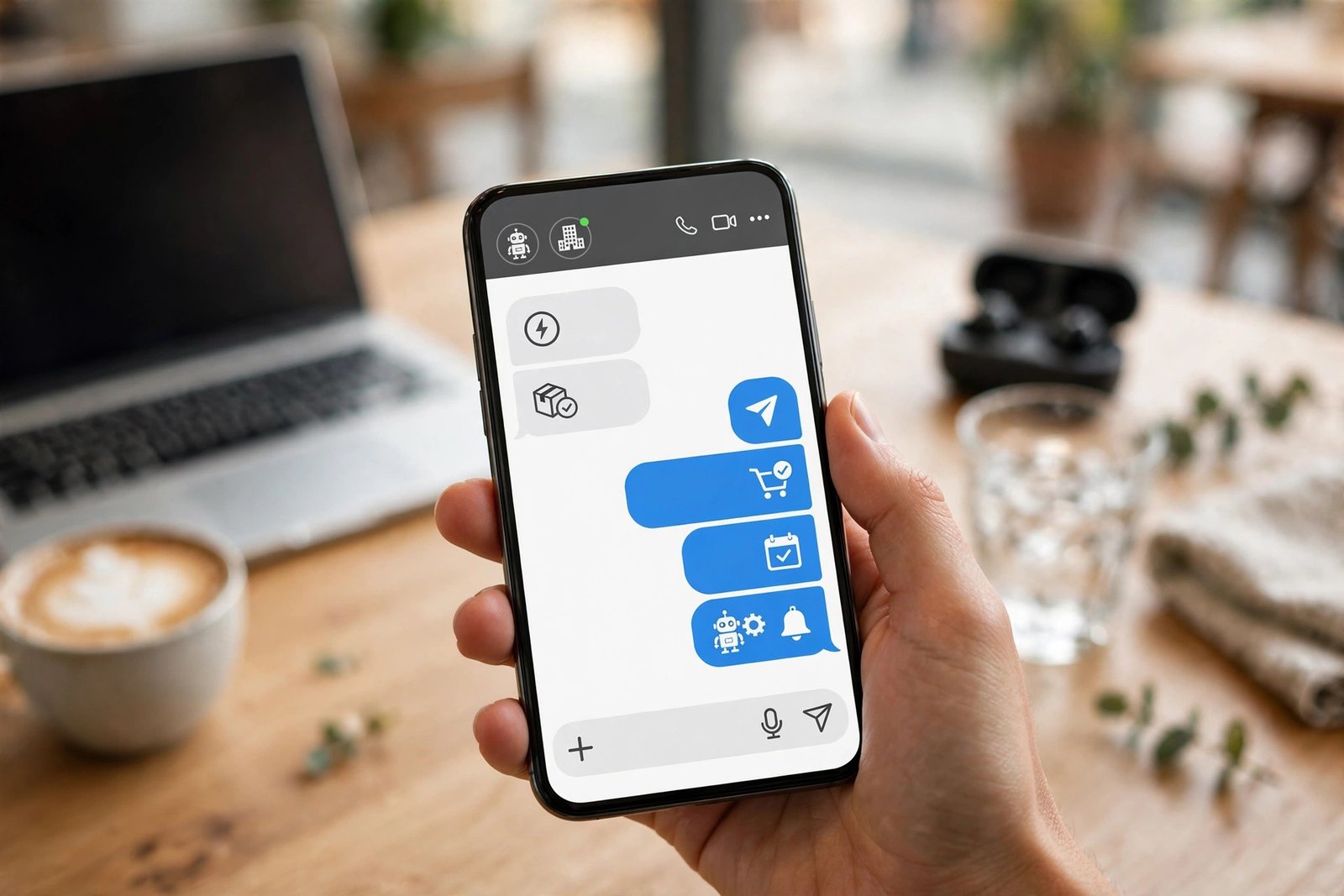
Nobody gives you straight numbers on this, so I will. These are typical market ranges for 2026, and they move around, but they will keep you from getting ripped off.
Tier one: free. The WhatsApp Business app, quick replies, away messages, catalog. Your cost is the hour it takes to set up. This handles the basics and I would argue every small business should be here at minimum. If a vendor tries to charge you a setup fee for this, walk away.
Tier two: $15 to $60 a month. A shared-inbox tool or a simple automation platform that connects to the WhatsApp API through a provider. You get a team inbox, basic auto-replies, templates for notifications, and usually some CRM integration. Meta charges per-message fees on top — typically fractions of a cent to a few cents per message depending on your country and message type — but for a small business sending a few thousand messages a month, this is pocket change.
Tier three: $100 to $500+ a month. A proper AI setup: an intelligent chatbot that qualifies leads, books appointments straight into your calendar, follows up on quotes, and hands off to a human when it should. This is done-for-you territory — someone builds the flows, writes the responses in your voice, and wires it into your systems. The monthly cost covers the platform, the message volume and the maintenance.
The mistake I see constantly is businesses buying tier three when they needed tier one, or struggling on tier one for a year when tier two would have paid for itself in a month. Match the spend to the pain. If missed messages are costing you two jobs a month, tier two is not an expense — it is the cheapest hire you will ever make.
What to automate first (in this order)
Everyone wants to start with the fancy chatbot. Do not. Automate in the order of money lost, and the order looks like this.
First: the instant reply. When someone messages you at 9pm and hears nothing until morning, a huge chunk of them have already messaged your competitor. An instant reply that says “Thanks for reaching out — we will get back to you by 9am, and here is our booking link if you want to grab a slot now” costs nothing and saves jobs. This single automation has the highest return of anything on this list.
Second: appointment reminders. No-shows are pure profit walking out the door. A reminder 24 hours before and another two hours before, sent automatically, cuts no-shows dramatically. Every clinic, salon, contractor and consultant I have worked with sees the same pattern: reminders pay for the entire system by themselves.
Third: lead qualification. When a new inquiry comes in, ask three or four questions before a human gets involved: what do they need, where are they located, what is their timeline, what is their budget range. The bot collects the answers and drops a tidy summary into your CRM or your inbox. Your sales conversations start at step four instead of step one.
Fourth: quote follow-up. You sent the estimate. They went quiet. Three days later an automated WhatsApp goes out: “Hi Sarah, just checking you got the quote — happy to walk through it whenever suits.” Then another at day seven. Then day fourteen. Contractors tell me this sequence alone recovers jobs they had written off. People do not reply because they are rude; they reply late because they are busy.
Fifth: review requests. After the job is done and the customer is happy, an automated message asks for a Google review with a direct link. Reviews are the fuel of local rankings, and asking on WhatsApp — where the customer actually reads it — beats asking by email by a mile.
Get those five running before you even think about anything cleverer. They cover the entire customer journey from first message to review, and together they are worth more than any single “AI” feature a vendor will demo for you.
What I would skip (for now)
Broadcast marketing blasts to your whole WhatsApp list. Meta is strict about this — you need opt-ins, approved templates, and one spam complaint too many gets your number restricted. I have seen businesses get their number banned a week before their busy season because someone got enthusiastic with promotions. Build the service automations first. Marketing blasts can wait until you understand the rules.
I would also skip the all-singing AI agent that tries to handle everything on day one. Start narrow — booking, reminders, follow-up — and expand once those are working. The businesses with the best results started boring and got ambitious later, not the other way around.
The UK and Australia angle nobody talks about
If you serve customers in the UK or Australia, WhatsApp is not a nice-to-have, it is the default. In those markets, customers expect to message a business the same way they message friends, and a business without WhatsApp looks behind the times. In the US it is catching up fast, especially with younger customers and immigrant communities where WhatsApp has always been the standard.
This matters for prioritization. A trades business in Manchester or Sydney should treat whatsapp business automation as core infrastructure, up there with the website. A B2B consultancy in Ohio can treat it as a strong second channel. Know your market.
WhatsApp messages are opened at rates email marketers can only dream about — industry data consistently puts open rates near 98%, against roughly 20% for email. When the message matters, the channel matters.
How we approach it at Digital Surgeons Hub
We have built WhatsApp automation for 700+ brands, and the pattern is always the same: the businesses that win are not the ones with the cleverest bot, they are the ones that stopped missing messages. Our average time to first measurable win across all automation work is fourteen days, and WhatsApp projects tend to be on the faster end of that because the impact is so immediate.
We usually start with a chatbot and messaging audit — we look at how inquiries reach you now, where they die, and which three automations would pay for themselves fastest. Then we build in stages through our workflow automation process so nothing disrupts how you already work.
Frequently asked questions
Is WhatsApp automation legal for small businesses?
Yes, with two conditions: customers must opt in before you send them proactive messages, and you must identify your business clearly. Service messages (booking confirmations, reminders) are straightforward. Marketing messages need explicit consent and approved templates. Stay inside those lines and you will never have a problem.
Can I automate WhatsApp without the Business API?
Partly. The free WhatsApp Business app gives you quick replies, greeting messages and away messages — enough for basic automation. But anything connected to your CRM, website forms or team inbox needs the API. If you are pasting the same answers fifty times a day, you have outgrown the free app.
How long does it take to set up?
The free app setup takes an afternoon. A tier-two shared inbox with basic automations takes a few days. A full done-for-you build with AI qualification, booking and follow-up sequences typically takes two to three weeks including testing. Our average time to first win across automation projects is fourteen days.
Will customers know they are talking to a bot?
Only if you build it badly. A good setup is transparent about being automated for routine stuff (“I am the booking assistant”) and hands off to a human the moment things get complicated or emotional. Customers do not mind automation — they mind being trapped by it.
What to do next
If messages are slipping through the cracks, do not overthink this. Start with the instant reply and the reminders this week — they are the two highest-return automations and the cheapest to set up. Then work down the list.
And if you want someone to map the whole thing out for your business specifically, get a free audit from Digital Surgeons Hub. We will look at how inquiries flow through your business today and show you exactly which WhatsApp automations would pay for themselves first. No obligation, no pushy sales call — just a straight answer.
Ready to Grow With AI Automation?
You don’t need a grand AI strategy. You need one workflow, automated well, measured honestly — then the next. We’ll audit your processes and show you exactly where AI pays for itself.
Book Your Free Automation Audit
Free · No pitch decks · No lock-in · You keep the roadmap either way