Web Design for Local Businesses: The 2026 Playbook
- 01How local customers actually choose (and what
- 02The non-negotiables for every local business
- 03What local business websites do NOT need
- 04Affordable web design: what should it actuall
- 05DIY builders vs hiring a designer
- 06Local SEO foundations your designer should in
- 07Frequently asked questions
- 08FAQ
A local business website has exactly one job: turn nearby searchers into paying customers. Not win design awards. Not impress other designers. Get the phone ringing, the bookings filled, the trucks rolling. Yet most web design for local businesses fails this simple test, because it is built like a mini corporate site instead of a local customer machine.
We work with local and small businesses across the US, UK, Canada, Australia, and beyond, from plumbers in Texas to clinics in Sydney. The fundamentals are identical everywhere: local customers search, compare quickly, and choose based on trust signals and ease of contact. Here is the complete playbook for getting it right in 2026.
How local customers actually choose (and what your site must do)
Picture your customer. Their AC dies at 9pm. They Google “AC repair near me.” They tap the first result that looks legitimate, scan for reviews and a phone number, and call. Total decision time: under two minutes. Your website is being evaluated in seconds, on a phone, often in a moment of urgency.
This means web design services for small business live or die on three things: instant credibility, frictionless contact, and local relevance. Everything else is decoration.
The non-negotiables for every local business website
1. Phone number everywhere, tappable
Your phone number should be in the header on every page, tappable on mobile, and repeated near every call to action. This sounds obvious. An astonishing number of local sites bury it in a contact page. For service businesses, the phone call is the conversion. Treat it like one.
2. Reviews front and center
Local customers trust reviews more than anything you say about yourself. Google reviews, ideally 4.5 stars or higher, visible above the fold or within one scroll. If you have fewer than 20 reviews, getting more reviews is a higher-ROI activity than any design tweak. Ask every happy customer. Make it a system, not a hope.
3. Service area clarity
“Serving the greater metropolitan area” means nothing. Name your cities and neighborhoods. Create dedicated pages for your top service areas with genuinely local content, not find-and-replace city names. This is both a conversion win (customers see themselves) and an SEO win (local relevance signals).
4. Real photos, not stock
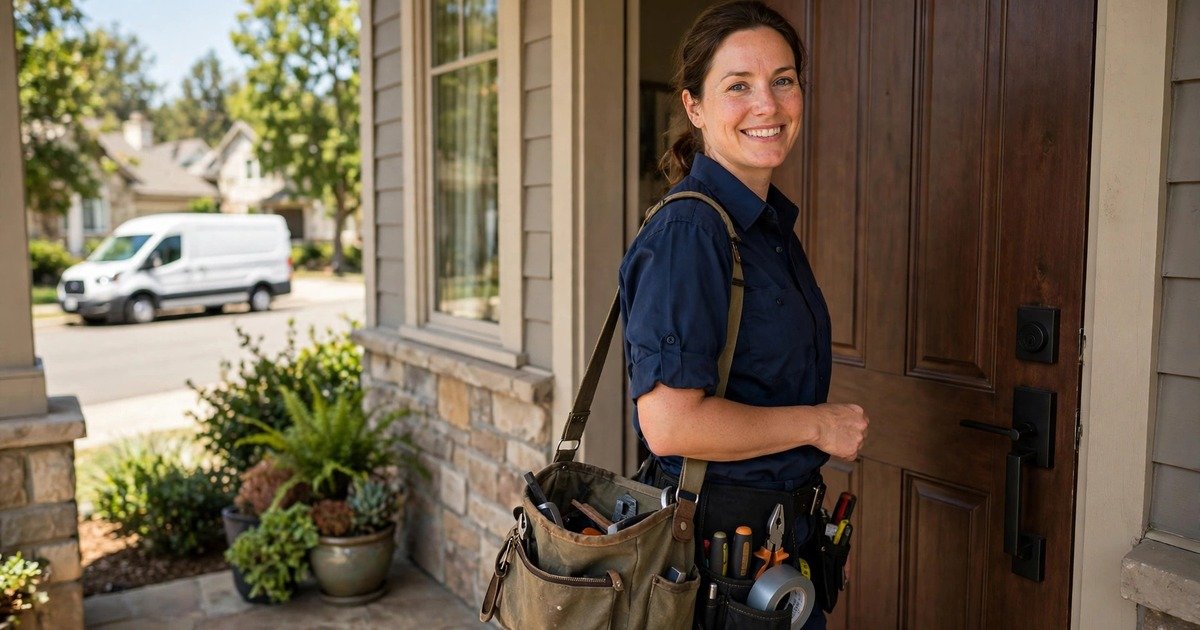
Stock photos of smiling models in hard hats destroy trust for local businesses. Customers want to see your actual trucks, your actual team, your actual work. Phone photos of real jobs outperform polished stock every time. Authenticity is the whole game locally.
5. Speed on mobile
Nearly all “near me” searches happen on phones. If your site takes more than 3 seconds to load on mobile data, a large share of potential customers bounce before seeing anything. Speed is not a technical nicety for local sites. It is the front door.
6. Google Business Profile integration
Your website and your Google Business Profile are a team. Consistent name, address, and phone number everywhere. Your site should link to your profile, and your profile should link to location-specific landing pages. Many local businesses treat these as separate. They are two halves of one presence.
What local business websites do NOT need
A blog nobody updates. (A dead blog is worse than no blog.) Fancy animations that slow everything down. Ten pages when three would do. A “mission statement” page. Chatbots for a three-person company. Most local sites need 5 to 8 strong pages: home, services, service areas, about, reviews, contact, and maybe pricing or FAQ. Depth beats breadth.
Affordable web design: what should it actually cost?
Let us talk honestly about affordable web design, because “affordable” is where local businesses get burned most. A solid local business website from a competent provider: $2,000 to $8,000. That gets you professional design, mobile optimization, local SEO foundations, review integration, and proper tracking.
Under $1,000, you are getting a template with your name on it, usually with corners cut on speed, SEO, and conversion. That can be a reasonable start if cash is tight, but know what you bought. Over $15,000 for a standard local site, and you should be asking hard questions about what the extra money buys.
The real cost trap is not the build price. It is the $99/month “maintenance” plan that does nothing, the SEO upsell with no deliverables, and the rebuild you need in 18 months because the cheap site never generated leads. Affordable means good value over time, not the lowest quote today.
DIY builders vs hiring a designer
Wix, Squarespace, and similar builders are legitimate options for very simple local sites. If your needs are truly basic and your budget is truly zero, a careful DIY build beats no site at all. But most local businesses outgrow DIY quickly: the SEO limitations, the generic look, the time sink of doing it yourself when you should be running your business.
The math that matters: if your time is worth $50+/hour and a DIY site takes you 40 hours, you just “spent” $2,000 plus the opportunity cost of leads lost to a mediocre site. Hiring a professional is often cheaper than DIY once you count honestly.

Local SEO foundations your designer should include
Any web design for local businesses should ship with local SEO basics: proper title tags with city + service keywords, schema markup for local business, NAP consistency, fast mobile performance, and location pages for key service areas. If your designer says “SEO is a separate service,” that is fine for ongoing SEO, but the foundations should be in the build. A site launched without them starts every ranking battle handicapped.
We build local business websites as customer machines: conversion-first design, local SEO foundations, review systems, and tracking that shows exactly where your leads come from. See our web design services or get a free quote. We work with local businesses worldwide, from US metros to Sydney suburbs.
Frequently asked questions
How much does web design for a small local business cost?
A professional local business website typically costs $2,000 to $8,000. Template-based builds can run under $1,500. The key is matching price to scope: a plumber needs a fast, trustworthy 6-page site, not a $20,000 custom build. Beware ongoing “maintenance” fees that deliver nothing.
Do I need a blog for my local business website?
Only if you will actually publish useful local content consistently. A dead blog hurts more than no blog. For most local businesses, strong service and location pages plus reviews outperform a neglected blog. If you can commit to monthly helpful posts, it becomes a real SEO asset.
How important are Google reviews for my website’s success?
Critical. Reviews are the top trust signal for local customers and a major local ranking factor. Aim for 4.5+ stars and keep them coming steadily. Display them prominently on your site. A systematic review-request process beats any design element for conversion impact.
Should I hire a local web designer or can I work remotely?
Remote works fine for web design. What matters is the designer’s local-business experience, portfolio of real local sites, and communication quality, not their zip code. We serve local businesses across the US, UK, Canada, and Australia remotely, and the results speak for themselves.
What pages does a local business website need?
At minimum: home, services (individual pages for main services), service areas, about, reviews/testimonials, and contact. Add FAQ and pricing if relevant to your trade. Five to eight strong pages beat fifteen thin ones every time.
How long until my new website brings customers?
A well-built local site can generate leads from day one if you already have traffic sources (Google Business Profile, ads, referrals). Organic search rankings typically take 3 to 6 months to build. The site itself should convert from launch; traffic growth is the longer game.
Ready for a Website That Actually Sells?
Stop guessing. Get a free diagnostic of your current site, or a scoped quote for a new one, and see exactly what is leaking revenue before you spend a dollar.
Get Your Free Website Audit
Free · No pitch decks · No lock-in · Honest feedback either way