AI Automation Agency for Small Business: The 2026 Buyer’s Guide
An AI automation agency designs and builds AI-powered systems , chatbots, workflow automations, CRM integrations , that take repetitive work off your team’s plate. For a small business, the right engagement starts with a single high-ROI workflow, goes live in weeks, and pays for itself through recovered hours and captured leads. This guide covers what these agencies actually do, what they cost in 2026, and how to choose one without getting burned.
What Does an AI Automation Agency Actually Do?
Forget the buzzwords. A real AI automation agency does three things: finds the repetitive work draining your business, builds AI systems that handle it, and connects those systems to the tools you already use.
That is different from an AI consulting firm. Consultants typically sell strategy decks and roadmaps; agencies ship working software. If someone’s proposal ends with a PDF instead of a login, you’re talking to the wrong vendor.
Here is what the work usually includes:
- AI chatbots that answer customer questions and capture leads around the clock , on your website, WhatsApp, or social channels. (AI chatbot services)
- Workflow automation that connects your apps and eliminates copy-paste busywork between them. (Workflow automation)
- CRM automation that routes, scores, and follows up with leads automatically so nothing slips through. (CRM automation)
- Lead generation automation that captures, qualifies, and books prospects while you sleep. (Lead generation automation)
- AI appointment booking that fills your calendar without phone tag. (AI appointment booking)
5 Signs Your Business Is Ready for AI Automation

You don’t need to “feel ready.” You need one of these five problems , and most growing businesses have at least three:
- Leads go cold after hours. If a prospect messages at 9 PM and hears back at 9 AM, you’ve already lost to whoever answered first.
- Your team lives in copy-paste. Re-typing enquiry details from email into the CRM, from the CRM into spreadsheets, from spreadsheets into invoices. Every hop is an hour lost and an error waiting to happen.
- Follow-up is inconsistent. Some leads get three calls, others get none , depending on how busy the day was. Automation doesn’t have busy days.
- Your tools don’t talk to each other. You’re paying for five subscriptions that behave like five separate businesses.
- Growth plans exceed hiring plans. You want 2x output without 2x headcount. That’s exactly the math automation solves.
If you nodded at two or more, an automation audit will almost certainly find a project with positive ROI. Start with our free website and marketing audit.
How Much Does an AI Automation Agency Cost in 2026?
Let’s talk numbers honestly, because most agencies won’t.
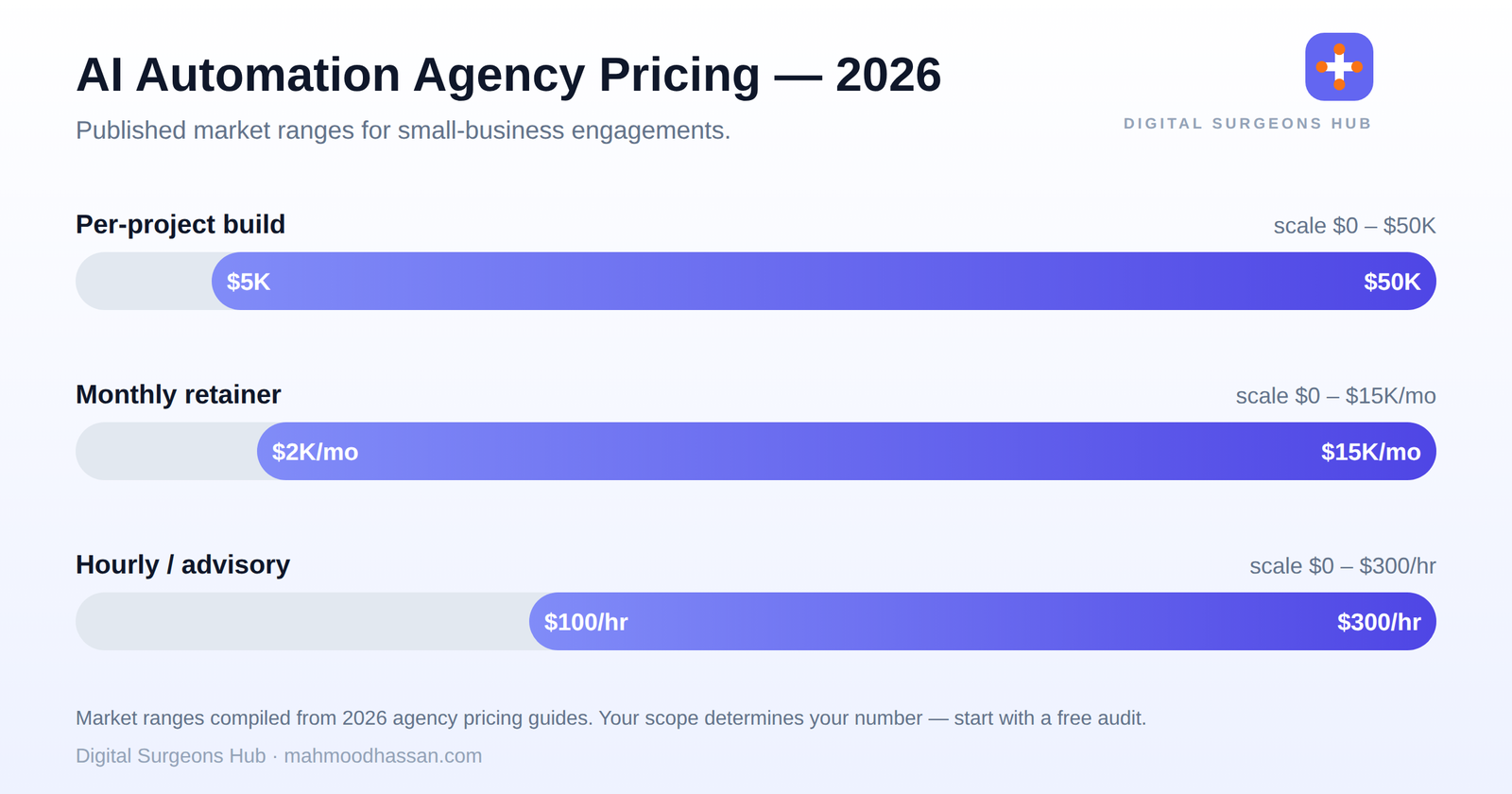
Published 2026 market data puts agency pricing in three bands. Per The Crunch’s 2026 agency cost guide: per-project builds run USD 5,000–50,000, monthly retainers USD 2,000–15,000, and hourly/advisory USD 100–300. Regional guides tell the same story in local currency , Australian SMB projects land around AUD 8,000–25,000 for a first engagement, Canadian single-workflow builds CAD 5,000–15,000. (Sources: thecrunch.io, jahanzaib.ai AU guide, deploylabs.ca.)
Three things drive where you land in those ranges:
- Number of workflows. One lead-routing automation costs a fraction of a ten-workflow operations overhaul. Start with one.
- Integration complexity. Connecting two modern tools with clean APIs is fast. Wiring a legacy system with no API is where budgets grow.
- Custom AI vs. configured platforms. A chatbot configured on proven platforms ships faster and cheaper than a from-scratch custom model , and for most SMB use cases, it’s also the better choice.
Our position: we don’t publish one-size-fits-all pricing because the audit determines the scope. What we do offer is a free automation audit , we map your workflows, rank the opportunities by ROI, and you keep the roadmap whether or not we build it. Book your free audit here.
Agency vs In-House vs DIY: Which Path Fits a Small Business?
| AI Automation Agency | In-House Hire | DIY (Zapier/Make) | |
|---|---|---|---|
| Upfront cost | $5K–$50K project | $130K+/yr fully loaded | $50–$500/mo tools |
| Time to first result | Weeks (our average: 14 days to first win) | Months (hiring + ramp) | Days , for simple flows |
| Best for | First initiative, results in 90 days | Permanent, high-volume AI workload | One or two simple zaps |
| Watch out for | Vet for ownership and documentation | Expensive if workload is lumpy | Breaks at complexity; no error handling |
- DIY is perfect for “when X happens, do Y” , until the workflow needs branching logic, AI decision-making, or graceful failure handling. That’s where DIY automations silently break at 2 AM.
- In-house makes sense once automation is a permanent, full-time workload. In year one, though, the agency wins on economics by a wide margin.
- Agency is the right call when you want a working system in weeks and want to test whether automation moves the needle before committing to headcount.
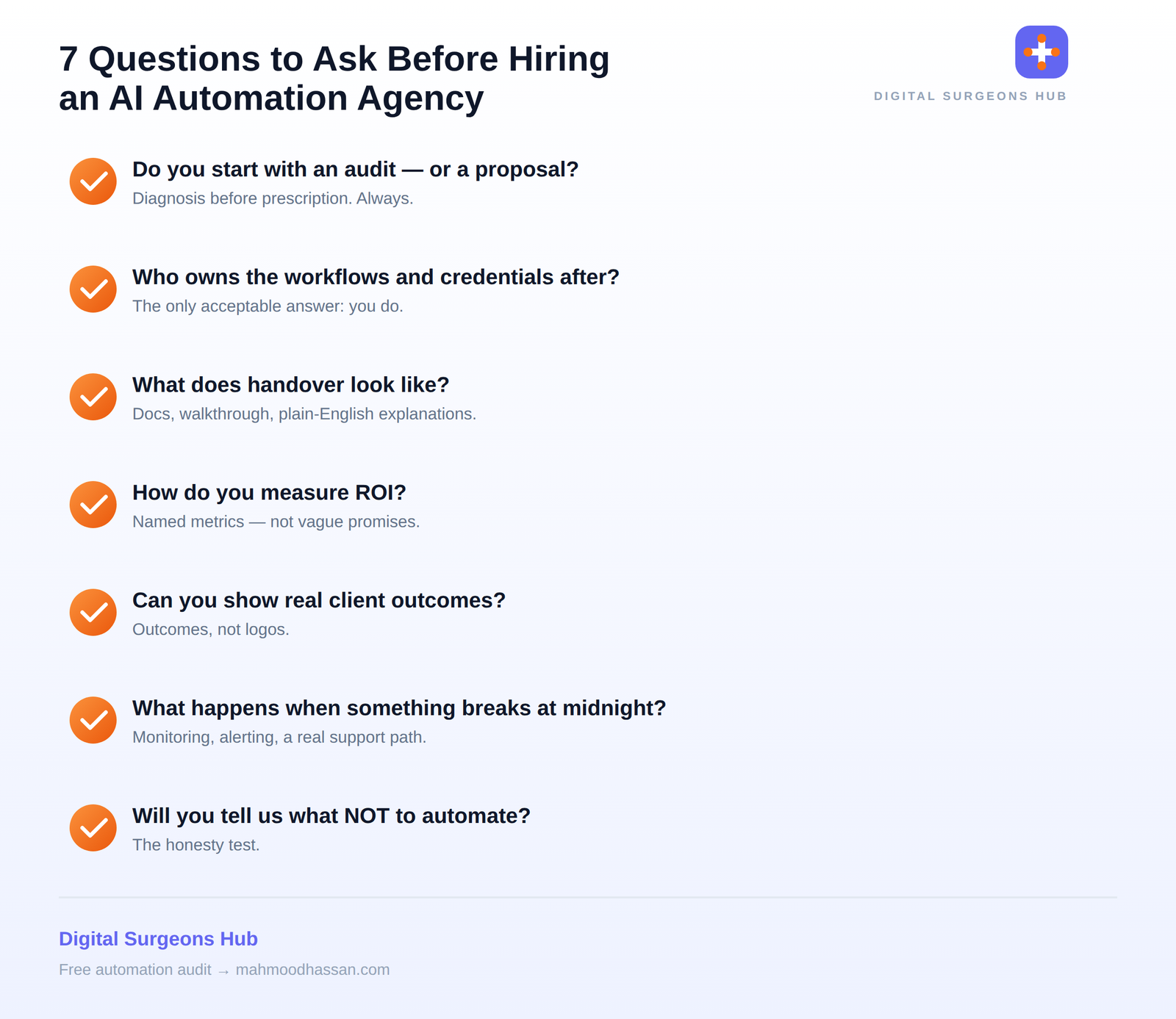
How to Choose the Right AI Automation Agency: 7 Questions
AI automation is in a gold-rush phase. Every web designer who watched two tutorials now offers AI solutions. The demos all look incredible, because demos are scripted. The difference shows up in month three, when the chatbot starts giving wrong answers, the automated workflow needs manual babysitting, and the agency that sold it to you has moved on to the next demo.
There is no licensing body, no standard certification, no review category you can trust. You are buying based on conversations and promises. So the questions you ask in those conversations are everything. They reveal whether you are talking to a practitioner or a salesperson. Ask every candidate these seven questions. The answers separate builders from pitch decks. The right agency talks about your numbers before their technology.
1. “Who owns what you build for me?”
This is the most important question on the list, and most buyers never ask it. Some agencies build your automation inside their own accounts, on their own infrastructure, with tools you cannot access. The day you stop paying, your system stops working, and you own nothing: not the workflows, not the training data, not the conversation history.
The right answer: you own the accounts, the builds live in your infrastructure or are fully transferable, and you get complete documentation. An agency confident in its ongoing value does not need to hold your system hostage. Vendor lock-in disguised as managed service is the industry’s oldest trap. Ask this first, because a wrong answer here disqualifies everything else.
2. “Do you start with an audit, and what will you need from us?”
A serious agency diagnoses before prescribing. If they quote before mapping your workflows, walk away. Ask to see a sample handover: documentation, a walkthrough recording, and a plain-English explanation your non-technical staff can follow.
And beware the agency that says “we handle everything, you do not need to do anything.” Every good build needs your input: your call scripts, your edge cases, your definition of a qualified lead, a few hours of your best employee’s time to train the system on how things really work. Expect roughly 3 to 4 hours of your time in the first two weeks, access to the systems involved, and one person who can answer “what should happen when” questions. That is a practitioner talking. “Nothing, we have got it” is a salesperson talking.
3. “What does this cost me in year two?”
The setup fee is the least interesting number in the proposal. What matters is total cost of ownership: monthly platform fees, per-conversation or per-minute charges, maintenance retainers, and the cost of changes when your business evolves.
I have seen $5,000 setups that cost $2,000 a month forever, and $15,000 setups that cost $300 a month to run. The sticker price tells you nothing. Ask for a 24-month total cost projection in writing, including the vendor’s own fees and every third-party subscription the system needs. If they cannot produce it, they have not thought about your economics, only theirs.
4. “Show me something you built that is still running a year later.”
Not a demo. Not a screenshot. A live system, in production, handling real customers or real operations, built more than a year ago. Then ask what broke in that year and how they fixed it.
This question filters out most of the market. Anyone can build a chatbot in a week. Keeping one accurate, useful, and maintained for a year requires monitoring, retraining, handling edge cases, and answering the client’s panicked email when something weird happens at 9 PM. You want the agency that has lived through the boring part. Not logos, outcomes. Our case studies are public: Crosby Intruder Alarms went from page 5 to page 1 on Google in 90 days and now gets daily organic enquiries without ad spend; a UK home-renovation brand went from zero to 12 page-one rankings in 4 months while cutting ad spend 35%. (Case studies)
5. “What happens when the AI gets it wrong?”
It will get things wrong. Any agency that says otherwise is lying or naive. The question is what the system does in that moment: does it escalate gracefully to a human? Does it log the failure so it can be fixed? Is there a human review loop for high-stakes interactions? Every build should ship with monitoring, alerting, and a support path. “We will fix it Monday” is not an automation strategy.
Listen for specifics, not reassurances. “Our AI is 99% accurate” is a reassurance. “Here is our fallback flow, here is how misclassifications get flagged, and here is the weekly review process” is an answer. You want the agency that has thought about failure, because failure is guaranteed.
6. “How do you measure whether this is working?”
If the agency cannot define success in your numbers, booked appointments, response time, hours saved, conversion rate, they will define it in theirs: conversations handled, messages sent, uptime. Those metrics can look great while your business sees zero benefit. Vague promises (“10x efficiency!”) are worthless. You want named metrics: hours saved per week, lead response time, capture rate, cost per qualified lead.
Before any build starts, there should be a one-page agreement: we are building X, it should move metric Y from A to B within Z days, and if it does not, here is what happens. Every build should ship with GA4, Google Tag Manager, and Looker Studio dashboards, so you see exactly what the automation did, in numbers, every month. (Marketing analytics)
7. “What is your kill criteria?”
The question that gets the most uncomfortable silence. Kill criteria means: under what conditions would you tell me to stop this project? A good agency has an answer: “if after 60 days the booking rate has not moved, we would recommend pausing and reassessing rather than continuing to bill you.” That answer tells you they will protect your money even when it costs them revenue.
An agency with no kill criteria will happily bill you for a failing system indefinitely. This is the honesty test. Roughly one in five audits should end with “do this one yourself” or “do not automate this yet.” You are not hiring a vendor. You are hiring a fiduciary for this part of your business. They should act like it.
Red Flags: Walk Away When You See These
A few patterns worth treating as disqualifiers. Guaranteed results: nobody can guarantee AI performance in your specific business; the honest ones give ranges and kill criteria instead. No live systems to show: only demos and mockups. A proprietary AI platform they will not explain: usually a white-labeled tool with a steep markup. Pressure to sign this week for founding client pricing: manufactured urgency is a sales tactic, not a business reality. And no questions about your business: if the discovery call is 90% pitch and 10% questions, they sell the same thing to everyone.
None of these means the people are bad. It means the business model is built for closing, not for delivering. You want the opposite.
Our Answers (Ask Us Anything Harder)
Fair is fair. Here is how Digital Surgeons Hub answers its own checklist:
- Ownership: you own everything: accounts, builds, data, documentation. If you leave, it all comes with you. We have structured 700+ client engagements this way and never had a dispute about it.
- Year-two cost: every proposal includes a 24-month total cost projection, third-party fees itemized. No surprises is a policy, not a promise.
- Systems still running: ask us on a call and we will show you live builds, including what broke and how we fixed it. The boring maintenance stories are the ones that matter.
- Failure handling: every build ships with escalation flows, failure logging, and a human review loop for high-stakes interactions. We design for the 10% that goes wrong, not just the 90% that goes right.
- Measurement: one-page success definition before we build, tied to your metrics. Our clients see their first measurable win in 14 days on average.
- What we need from you: a few hours in the first two weeks and one person who knows how your business really works. We will tell you exactly what and when.
- Kill criteria: if the numbers do not move within the agreed window, we tell you to pause, and we mean it. We would rather lose a retainer than bill you for a system that is not earning its keep. Our 4.9 rating exists because clients trust us with the bad news, not just the good.
What Results to Expect: Honest Timelines
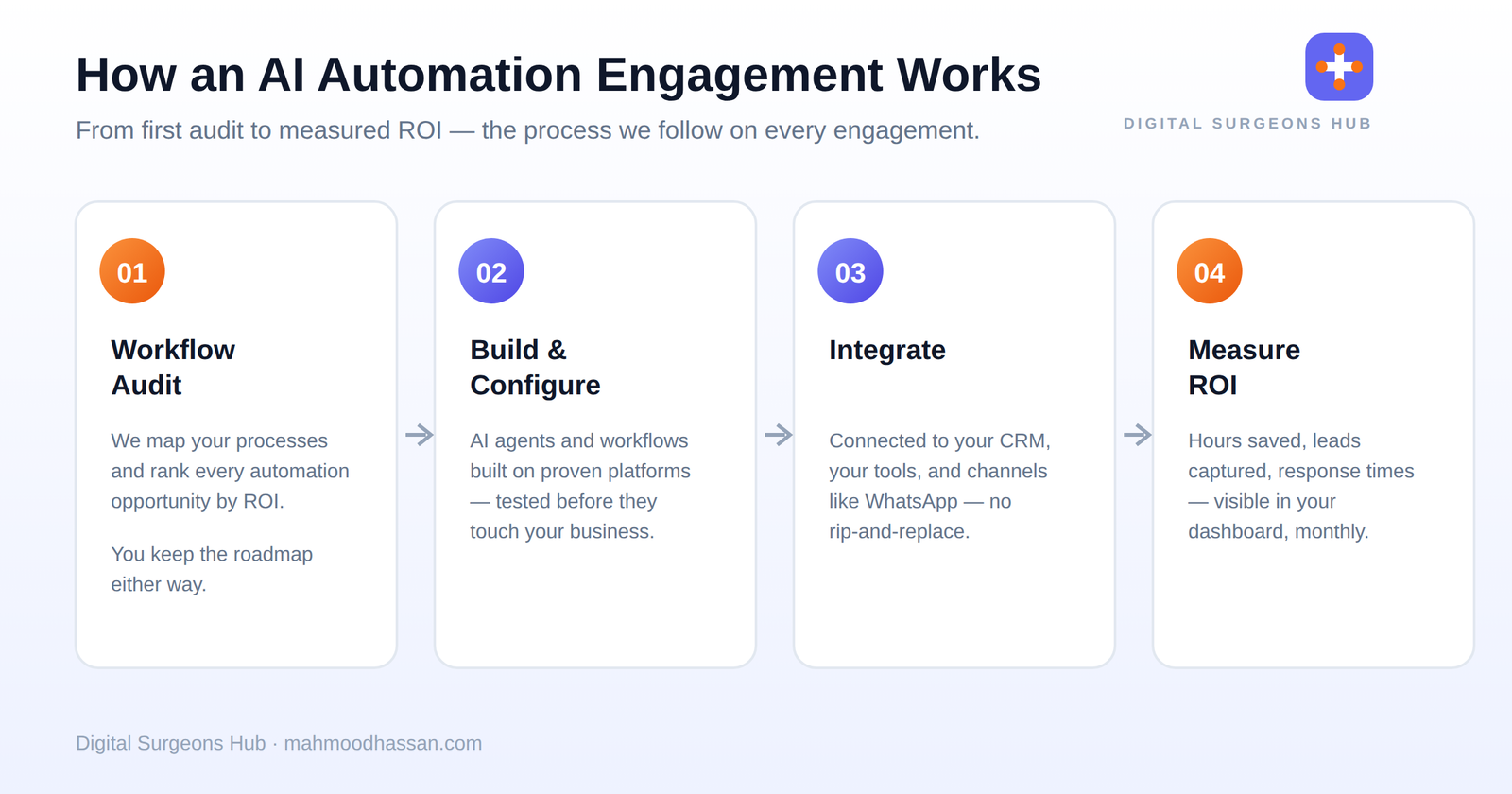
- Week 1–2: Workflow audit and ROI ranking. You know exactly what will be built and why.
- Week 2–6: Build, integrate, and test. Simple single-workflow builds ship fastest.
- Day 14 on average: our first measurable win lands , our tracked average across client work.
- Day 30–90: payback window for most SMB automations. The fastest returns come from lead recovery.
What we won’t do is guarantee specific revenue figures. Anyone who guarantees rankings, leads, or revenue before auditing your business is selling certainty they can’t manufacture. What we guarantee is instrumentation: you’ll see exactly what the automation did, in numbers, every month.
Why measurement matters: when we took Crosby Intruder Alarms from page 5 to page 1 in 90 days, the win wasn’t just the ranking , it was the dashboard proving daily organic enquiries at zero ad cost. We bring that same “prove it in the data” standard to automation: hours recovered, response times, capture rates.
FAQ: AI Automation Agencies
What does an AI automation agency do?
An AI automation agency builds AI-powered systems for your business: chatbots that handle enquiries, workflows that connect your tools, and CRM automations that follow up with leads. Unlike consultants who deliver strategy documents, agencies ship working software integrated into daily operations.
How much does AI automation cost for a small business in 2026?
Market data for 2026 puts single-workflow projects at roughly USD 5,000 to 15,000, with monthly retainers of USD 500 to 2,000 for ongoing support. Complex multi-system builds run higher. Most agencies start with a free or low-cost audit to scope the work before quoting.
Is it better to hire an AI automation agency or build in-house?
For most small businesses, an agency is cheaper in year one by a wide margin: a working system for 10,000 to 30,000 USD versus 130,000 USD or more fully loaded for a single in-house developer. In-house starts making sense in year two or three, once automation is a permanent full-time workload.
How long does it take to see results from AI automation?
A focused first project typically goes live in 2 to 6 weeks. Our tracked average for the first measurable win is 14 days. Full payback usually lands within 30 to 90 days, fastest from lead-recovery workflows.
Should I choose a specialist agency or a generalist that offers AI?
For your first AI project, choose whoever can show you live systems in businesses like yours. Specialization in your industry beats AI specialization in the abstract. A generalist agency that has deployed fifty chatbots for home-service companies will outperform an AI lab that has never talked to a contractor. After the first win, you can get more ambitious with specialists.
What is the difference between an AI automation agency and just buying software?
Software gives you tools; an agency gives you outcomes. A chatbot platform is $100 a month and an empty box. Someone still has to configure it for your business, integrate it with your systems, write the scripts, handle the edge cases, and maintain it. If you have the in-house skill and time, buy software. If you do not, you are not really choosing between software and an agency. You are choosing between doing it yourself and hiring someone who has done it before.
Will AI automation replace my employees?
No. It replaces the part of the week teams dislike: copy-paste, re-keying, chasing follow-ups, building reports. The time goes back into the work people were hired for: selling, serving customers, and growing the business.
Ready to Find Your Highest-ROI Workflow?
You don’t need a grand AI strategy. You need one workflow, automated well, measured honestly , then the next. We’ll audit your processes, rank the opportunities by ROI, and hand you the roadmap.
Book Your Free Automation Audit
Free · No pitch decks · No lock-in · You keep the roadmap either way